
eSIM Adventures in Europe: Staying Connected While Travelling

updated January 2026Sweaty backs and digging shoulder straps were our constant companions as the charming Scottish town of Oban morphed into a frustrating labyrinth. Circa 2019, my husband and I were trying to use our phones only in Wi-Fi, avoiding steep international roaming fees. Despite our foresight in carefully writing down directions, aware that Wi-Fi would be scarce, we'd somehow completed a dizzying three-lap tour of the town. Each repeated sighting of the same bus stop brought a fresh wave of embarrassment, a knot of panic tightening with every turn. Finally, desperation propelled me into a brightly lit, deliciously smelling kebab shop. But fate had one last ironic twist: the friendly faces behind the counter offered only smiles and nods, not a single word of English.

On our fourth attempt, remembering Einstein's wisdom about trying something new to get a different result, we finally veered off our well-worn path. And there it was! The elusive street, a welcome sight after our self-inflicted navigational nightmare. We practically collapsed inside our accommodation in a wave of exhaustion, tinged with the sheepish reflection of our circular folly.
That moment wasn’t really about getting lost.
It was about how quickly travel shifts from curious to stressful when you feel disconnected.
***If only eSIMs, with their instant access to maps and navigation, had been a "thing" back then!
eSIMs for Travelling from Now On!

Me and my connected phone
Want to avoid hunting for local SIM cards the moment you land or the stress of sky-high roaming bills? Trying to “live only on WiFi”? Enter the magic of eSIMs!
Say goodbye to fumbling with tiny, easily lost physical SIM cards and hello to significant cost savings! eSIMs offer convenience and cost-effectiveness rolled into one neat, digital package! This game-changer lets you purchase and activate data plans online, before you even leave home and activate with a few taps upon arrival.
This topic is EVER-CHANGING with technology and new offers. For example, Telus (in Canada) recently began offering a 15 or 30-day Europe roaming package that includes calls and texts. Bottom line - dig around for options. But I hope that this post helps you understand eSIMs and how they might be your travel answer to staying connected!
A quick note before we get into the how…
I don’t share tools like this because they’re trendy.
I share them because of how they shape the feeling of a trip.For me, staying connected isn’t about being online all the time.
It’s about:
feeling oriented instead of lost
having the freedom to follow curiosity
reducing those small, draining stress moments.
Connectivity is one of those quiet supports that can completely change how a trip feels.
What is an eSIM?
Think of an eSIM – also known as a digital SIM or embedded SIM card – as your phone's international secret agent for staying connected.
You have probably fumbled with that teeny-tiny plastic card inserted into your phone. SIM cards are data chips that carry all of your account information, allowing a phone to connect to a cellular network. In your home cellular network, they allow you to make calls, send texts or use data services. As soon as you leave your network (for me, that’s in Canada), the phone “ROAMS” to find a new network to connect to, which costs extra - a lot extra!
SIM cards can be physically swapped out for a new phone number in a new country to connect to a new network, but the process is cumbersome. Travellers have to find a phone store in the airport, fumble with multiple SIM cards that are easily dropped or lost, and then have a new number.
An eSIM, on the other hand, is virtually embedded right into your device. It's like having a SIM card living inside your phone, ready to spring into action. The cool part? It does everything digitally! Most (but not all) phones can use this technology. You simply download a data plan - just like grabbing an app - and then install it for instant connection to a mobile network as soon as you land in the country.
It's all the connectivity without the fiddly bits or big price tag.
Big cost saving
As of spring 2025, just one day of international roaming on a typical Canadian phone plan costs a whopping $16! Let that sink in. Now, compare that to Airalo, where a mere $16 delivers a massive 5GB of data valid for a whole 30 days in Spain. That's seriously a ton of data – I barely even nibbled through 2GB during an entire month! On our first long, leisurely 10-week adventure, even if we'd only dared to tap into our Canadian roaming every fourth day, we'd be staring down a $280 bill. Instead? We paid a grand total of $35 and enjoyed the glorious freedom of having data at our fingertips every day, anytime we needed it, day or night!
Navigation Convenience

A maze of streets in Sevilla
For a glorious month, our apartment in Seville, nestled on the edge of the old town, quickly revealed the true meaning of "twisting streets." Forget simply going around the block; Seville's ancient core is a delightful, disorienting maze that demands frequent consultation with phone navigation – trust me, we learned that the hard way! Over those weeks, a playful challenge emerged: could we find our way back to our apartment "without looking"? We did, eventually, but it involved numerous furtive glances at that reassuring little blue dot on our phone for a quick orientation check. Now, recounting this might paint a picture of my husband and me possessing zero sense of direction. But our navigational pride (well, his pride) was gloriously validated during a walking tour. Our local guide, with a knowing smile, assured us that even locals rely on their phones to navigate the intricate web of the old city's core!
Read more about my experiment to stay in one place for a month - here!
Travel Flexibility
Planning recent journeys along the South West Coast Path in the UK, into the charming corners of Northern France, across the vibrant landscapes of Morocco, and on the sunny streets of Spain, I quickly realized each country has its own unique cellular network. The thought of juggling four separate little SIM cards, or worse, or surviving in Wi-Fi areas only, felt stressful. That's where the magic of eSIMs truly shines! My phone became a digital vault, effortlessly holding multiple eSIM profiles. As I hopped from the cliffs of England to the bustling souks of Marrakech and finally the tapas bars of Madrid, connecting was a breeze – just a few simple taps and I was online in a new country. Even better? Regional eSIMs exist, meaning you can snag one plan that covers a whole bunch of countries, making the whole process even smoother!
Getting Set Up (It’s Easier Than You Think)
This might sound technical, but in practice it’s surprisingly simple.
Once you’ve done it once, it takes just a few minutes.
Here’s the flow:
Check your phone is compatible
(Most newer phones are)Choose your plan
Based on where you’re going and how you’ll use your phone
(Tip: it’s extremely easy to top up eSIM cards for more data or time - don’t feel the need to buy more than you need!)Install it before you leave
This is the part that makes everything smoother. Just keep the eSIM OFF until you arrive in that country - you won’t use any time or data until you turn it on.Turn it on when you arrive
And you’re connected within minutes.
That’s it. No searching for SIM cards. No swapping tiny chips. No guessing.
Choose an eSIM Provider & Plan
There are a ton of eSIM companies (e.g. Airalo, Simify, Sally, AloSim, Holafly). After using eSIMs across multiple countries and 3 continents, and testing more than one provider, here’s what I’ve noticed:
Not all eSIMs are about price.
They’re about how you travel.

For flexible, multi-country travel with light everyday use
→ Airalo is easy, reliable, and does the job beautifully

For heavier use or if you don’t want to think about limits
→ Simify offers more freedom
Neither is “better.”
They support different kinds of travellers.
Before choosing a plan, ask yourself:
“What do I actually need from my phone on this trip?”
Not what you should need.
What would make you feel more at ease?
Once you decide, it’s simply a matter of downloading the app and setting things up before you go.
Keeping Connected without using your Cell Number

Remember, when you're using an eSIM, your regular phone number won't function as normal for calls and traditional texts (unless your provider/phone supports Wi-Fi calling using your home number over the eSIM data, which can vary). But you WILL have data access in the country you're in! This means you can still communicate seamlessly with people via the internet. Think:
Facebook Messenger or Instagram DMs
Email
WhatsApp (which is very widely used throughout Europe!)
Photo-sharing apps
iMessage (if you and the other person have iPhones, messages will go through using data).
Uh Oh, It's Not Working! Troubleshooting Your eSIM in Europe
Don't panic! Sometimes technology hiccups, but here are a few things to try if your eSIM isn't connecting as expected. AND if you are using Airalo, their support team are notoriously SUPER HELPFUL with problem solving!
Check the Obvious First:
Airplane Mode: Ensure airplane mode is turned OFF. This seems basic, but it's a common oversight, especially after a flight.
Verify that cellular data is the correct eSIM and is turned ON in your device settings.
eSIM Selected for Data: Double-check that your newly activated eSIM is selected as the preferred network for mobile data (especially if you have a physical SIM or multiple eSIMs).
Restart Your Device - Sometimes, a simple restart can resolve connectivity issues.
Verify Data Roaming is ON for the country’s eSIM - Data roaming might need to be enabled for your phone to find and connect to the provider. This can be counterintuitive, but is sometimes necessary. It won’t be roaming on your home SIM because you’ve turned that off - so no extra charges will happen!
Check Your Data Balance/Plan Validity - check if you've used up your data allowance or if your plan has expired.
Confirm you are in service! In the Atlas Mountains of Morocco, we were far from cell towers, so we simply didn’t have any connection! Forced digital break!
Contact your eSIM Provider's Support - here’s Airalo’s help page! … Here is Simify’s!
A Little Heads-Up About Two-Factor Authentication (2FA) - Learn From My Oops!
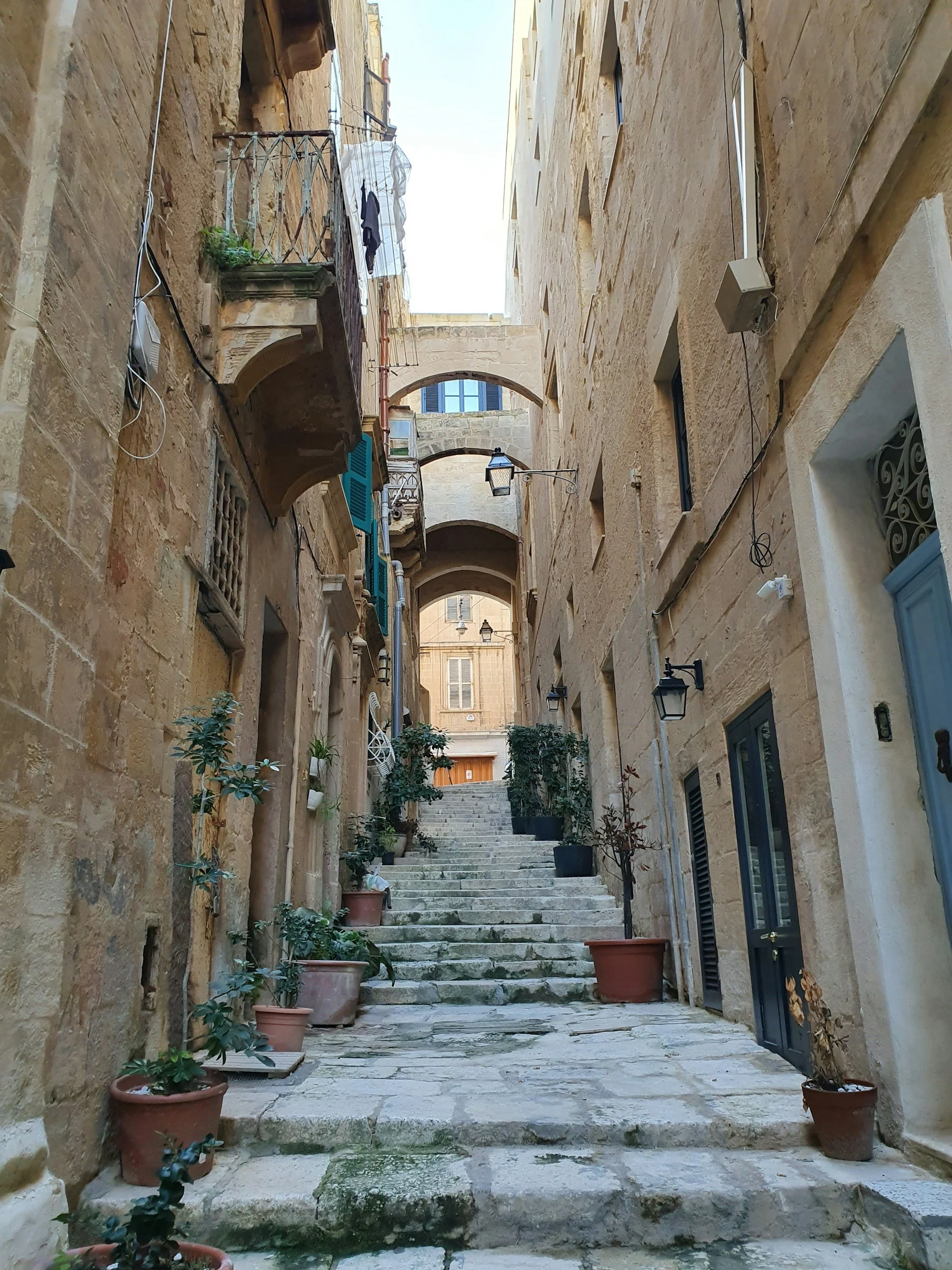
Good to be connected in Malta!
Let me share a cautionary travel tale – a lesson learned the hard way, all thanks to two-factor authentication (2FA). This took me by surprise during one trip when we were in the Rome airport, about to board a late-night flight to Malta. Out of the blue, the property management for our accommodation emailed a link requesting full payment before they'd send the access code. Why this hadn't happened sooner is still a travel mystery (though I'll own a sliver of responsibility). "No problem," I thought confidently, whipping out my trusty ScotiaBank no-foreign-transaction-fee credit card. But then... BAM! A 2FA pop-up appeared, and the only option? My useless Canadian cell number! I was completely locked out of receiving those vital verification texts because my eSIM was set up for European data.
Cue a minor heart attack. To add insult to injury, something wonky happened with our backup credit card, too. So, there we were, stuck in a foreign airport, forced to swallow a day of exorbitant data roaming fees just to receive that darn 2FA text! That moment reminded me: staying connected isn’t just convenience, it’s access.
Ugh. Lesson thoroughly learned: Before you jet off, double-check your important accounts and make sure you have a backup 2FA method like email or an authenticator app. Trust me on this one!
Tips for a Smooth eSIM Experience in Europe - again, learn from my oops!

Beautiful Bordeaux
On a last minute whim, my husband and I caught a short flight from Lisbon to Bordeaux for a week. We landed in Bordeaux, France at midnight, knowing there was one last public bus into the city. So we sprinted off the plane—carry-ons jostling over our shoulders—and just made it on board, breathless but triumphant.
Then came the eSIM saga. We had not yet installed or activated an eSIM for France. Cue late-night travel brain, a ticking clock, no Wi-Fi on the bus, and zero idea where to get off. For a solid 10 minutes, we fumbled through settings and instructions leading towards full-blown panic mode. Stubbornly avoiding asking anyone, I finally hit the right combo—network found, connection made, and tadaaa! We rang the bell and the bus doors opened just around the corner from our hotel. We’d arrived - phew!
That 10-minute scramble? Completely avoidable. And exactly the kind of stress I now try to design around.
Lesson? Where possible, install the eSIM before you go and activate it in Wi-Fi (like the airport terminal) just in case you need to refer to instructions or troubleshooting tips!
If travel is about feeling more like yourself, not less, then the small supports matter.
For me, an eSIM has become one of those quiet, behind-the-scenes tools that lets me stay present, curious, and a little more at ease wherever I land.

I hope this article helps you to plan your next adventure! Looking for more guidance?
Check out Ignite Your Inner Explorer, a coaching package to transform your travel whims and wishes into extraordinary journey ideas tailored just for you.